
What Is the Jones Act?
If you work on a vessel and got hurt on the job, chances are someone has already told you to "look into the Jones Act." It gets thrown around a lot in dockside conversations and Facebook groups, but most injured mariners don't actually know what it is, who it covers or why it matters so much to their recovery. Here's a straight answer.
The Short Version
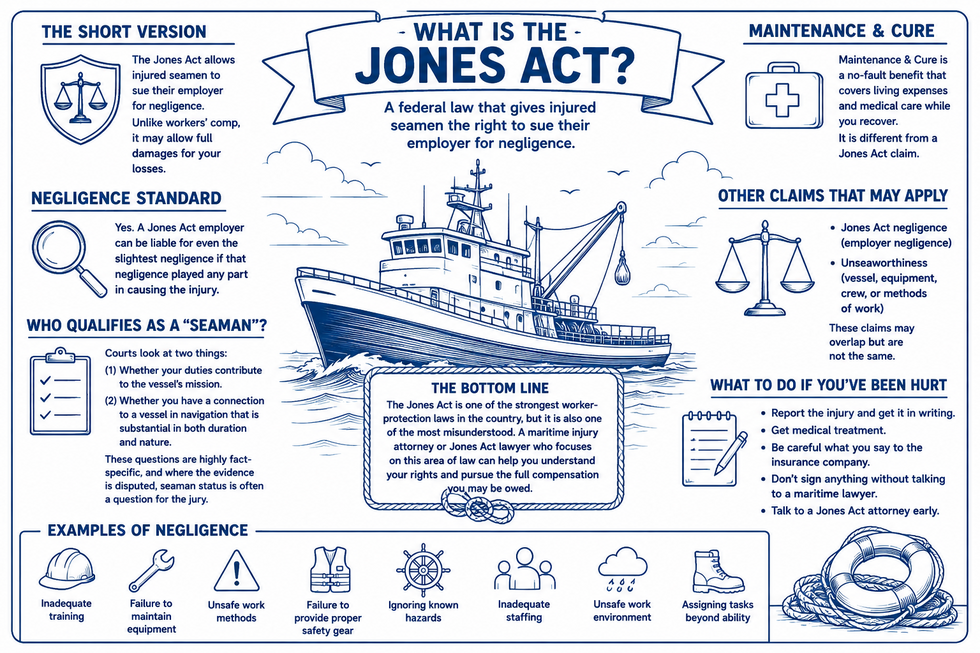
The Jones Act is a federal law (officially part of the Merchant Marine Act of 1920) that gives injured seamen the right to sue their employer for negligence. That's it in one sentence, but that one sentence is enormously important. Before the Jones Act existed, an injured seaman had almost no real recovery options against a negligent employer. Congress passed the law specifically to protect mariners, and over a century later it's still the backbone of maritime injury law in the United States.
Unlike a typical land-based workers' compensation claim, where an injured worker gets a fixed, limited payout regardless of fault, the Jones Act allows an injured seaman to pursue full negligence damages lost wages, past and future medical costs, pain and suffering, and more if the employer's negligence played any part in causing the injury.
Wait – Is the Negligence Standard Different Under the Jones Act?
Yes. Under the Jones Act, an employer may be held liable where its negligence, however slight, played any part in causing the seaman's injury.
Who Qualifies as a "Seaman"
This is where a lot of injured workers get tripped up, and it's exactly the kind of question a Jones Act lawyer gets asked constantly. Not everyone who works around water or on a vessel automatically qualifies for Jones Act protection. Courts generally look at two things: (a) whether your duties contribute to the function of the vessel or the accomplishment of its mission and (b) whether you have a connection to a vessel in navigation that is sufficiently substantial in both duration and nature. (And most times these two elements are for a jury to decide.)
The Jones Act covers a wide range of workers: commercial fishermen, deckhands, tugboat crew, barge workers, ferry employees, offshore supply vessel crew, yacht crew, professional sailors and many others. A maritime injury lawyer, for example, deals with this seaman-status question on nearly every case and they are very knowledgeable as to the law and can help you avoid a marine insurer's efforts at muddying the analysis.
What if My Employer Didn't Do Anything on Purpose: Can I still have a Claim?"
Yes, and this is one of the most misunderstood parts of the admiralty law. The Jones Act doesn't require intentional misconduct. It only requires negligence (a failure to use reasonable care) and the causation standard (meaning did the failure cause the injury) under the Jones Act is much lighter than shoreside law. Courts describe it as "featherweight causation," meaning the employer's negligence doesn't have to be the main cause of your injury. It only has to play some part, however small, in bringing it about.
Negligence under the Jones Act can look like:
- Inadequate crew training or staffing
- Failure to maintain equipment or machinery in safe working order
- Unsafe work methods or rushed operations
- Failure to provide proper safety gear
- Ignoring known hazards on deck or in the engine room
- Assigning a task beyond a crew member's training or physical capability
- An unsafe work environment
- And many other situations
If any of that sounds familiar, it's worth having a maritime injury attorney review the specifics.
I'm Already Getting Maintenance & Cure from My Employer. Isn't that the Same Thing as a Jones Act Claim?
No, and this distinction trips mariners up constantly – maybe because marine insurers and their representatives don't make it clear. Maintenance & Cure is a separate, no-fault obligation that a vessel owner typically owes an injured seaman almost automatically. Maintenance & Cure covers basic daily living expenses (Maintenance) and medical treatment (Cure) while you recover, regardless of who caused the injury.
A Jones Act negligence claim is different. It's a fault-based claim for full damages, and it exists on top of, not instead of, Maintenance & Cure. An injured mariner can pursue both at the same time, and often a general maritime law claim for "Unseaworthiness" as well. An Unseaworthiness claim addresses whether the vessel, its equipment, crew or methods of work were reasonably fit for their intended use.
Marine insurance companies and vessel operators know most injured crew members don't understand these distinctions. That gap in understanding is exactly how legitimate claims get undervalued or closed out early with a lowball settlement.
Why the Jones Act Matters So Much
Working on a vessel can be dangerous. The workplace is full of hazards with real risks of injury. Unpredictable seas, long hours and equipment that takes a beating from saltwater and constant use. When something goes wrong, the financial fallout for the injured worker and their family can be severe, especially since many mariners are paid on a share or per-trip basis rather than a steady wage.
This is precisely why the Jones Act exists and why it's written to favor the injured seaman. An offshore injury lawyer who regularly handles these cases understands the operational realities of vessel work from watch schedules, deck operations and gear handling to engine room hazards and can translate that into a claim that accurately reflects what happened and what it actually costs the seaman going forward.
What to Do If You've Been Hurt
If you've been injured while working aboard a vessel, a few things matter right away:
- Report the injury immediately and get it documented in writing.
- Get medical treatment and be honest and thorough about how the injury happened.
- Be careful with any statement you give to your employer's insurance representative before speaking with an attorney.
- Don't sign anything including settlement paperwork or medical authorizations without at least talking to a maritime lawyer – you don't have to hire them, just know your rights!
- Talk to a Jones Act attorney early, even if you're not sure yet whether you want to pursue a claim. The facts and evidence in these cases are often time-sensitive.
The Bottom Line
The Jones Act is one of the strongest worker-protection laws in the country, but it's also one of the most misunderstood. Qualifying as a seaman, proving negligence and untangling it from Maintenance & Cure and Unseaworthiness claims all require a working knowledge of maritime law that most general injury attorneys simply don't have. If you've been hurt on a vessel, working with a maritime injury attorney or Jones Act lawyer who focuses specifically on this area of law rather than a general personal injury firm handling it as a side matter makes a real difference in how your claim is built and ultimately valued.
How do I Learn More About the Jones Act, Unseaworthiness and Maintenance & Cure?
Easy! Click HERE for instant access our FREE Maritime Rights Booklet that explains these concepts in greater detail.
Fulweiler llc
East Coast Maritime Injury Lawyers
1-800-383-MAYDAY (6293)

Comments
There are no comments for this post. Be the first and Add your Comment below.
Leave a Comment