
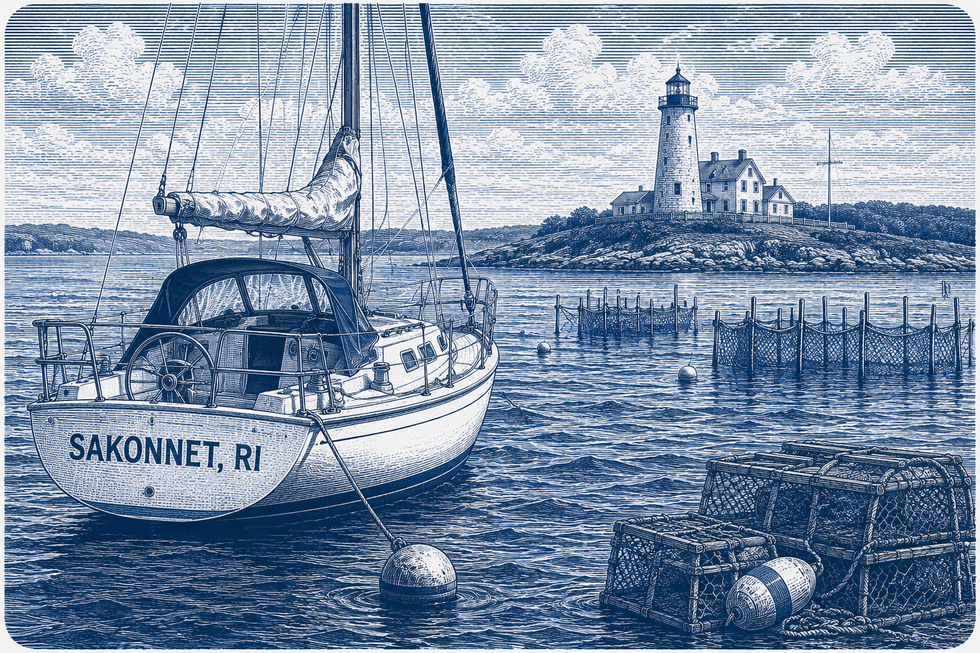
The Sakonnet is Rhode Island's quiet coast. East of Aquidneck Island, between Tiverton and Little Compton, the Sakonnet River runs wide and uncrowded — lobster boats working out of Sakonnet Harbor, sailboats reaching up past Fogland Point, anglers drifting the ledges off Sachuest, families anchored off the beaches on a summer afternoon. It feels gentler than Newport Harbor or Point Judith. It isn't. Most days on the Sakonnet end the way they should. Some don't.
Boating accidents on the Sakonnet River and its approaches involve all types of vessels, including center consoles, sportfishing boats, sailboats, lobster boats and commercial fishing vessels, jet skis (personal watercraft), dinghies, kayaks and paddleboards.
If you're searching for a boat accident lawyer serving Sakonnet, Tiverton, Little Compton and Rhode Island waters, it's important to find a boating accident attorney with knowledge of maritime law and boating injury lawsuits — that distinct body of federal law that governs what happens when things go wrong on the water. That's what we do.
The Sakonnet's Quiet Waters Have Sharp Teeth
The federal government's navigation guide, the U.S. Coast Pilot, describes a river that punishes complacency. Start with the warning that should give every boater pause: aside from the breakwater light at Sakonnet Harbor, there are no lighted aids to navigation in the entire river — NOAA's own guidance is that strangers should not attempt to run the Sakonnet at night. In an era of GPS overconfidence, an unlit river full of rocks is a trap waiting for the operator who trusts a glowing screen more than the water in front of him.
And the rocks are everywhere. Sakonnet Point itself is surrounded by bare and submerged rocks, with islets scattered to the south and Schuyler Ledge lying under just ten feet of water about a mile off the point. On the western side of the entrance, the Coast Pilot warns vessels never to pass between Cormorant Rock and Cormorant Reef, where the depth shrinks to four feet. Inside the river the list keeps going: Flint Point Ledge, the ominously named Old Bull covered by only two feet of water near Church Point, Almy Rock bare at low tide off Fogland Point, and rocky shoals that demand nearly half a mile of clearance along the Aquidneck shore.
The north end is the kicker. At Tiverton, the bridges act like dams, holding the water at different levels on either side and driving currents that change with startling speed in both strength and direction — a "double flood" running better than two and a half knots through a channel squeezed to one hundred feet between old bridge abutments. Mix in Sakonnet Harbor's fishing fleet, Tiverton's marinas and tanker wharves, anchored boats in the bight at Fogland, Little Compton beaches, and weekend traffic bound up to Mount Hope Bay, and the quiet river has everything it needs to produce groundings, collisions, capsizes and passengers thrown by a dangerous wake.
Sakonnet's commercial fishing fleet, aquaculture operations, marinas and tanker facilities can also create unique liability issues not commonly encountered in ordinary recreational boating accidents.
When a boating accident happens on waters like these, the question is rarely whether conditions were challenging. It's whether the vessel operator handled them the way a reasonable, careful operator should have.
Common Causes of Sakonnet Boating Accidents
Most boating accidents on the Sakonnet come down to vessel operator negligence. Common causes include:
- Running the river at night or in fog despite the absence of lighted navigation aids
- Striking charted rocks and ledges through inattention or overreliance on electronics
- Failing to maintain a proper lookout in violation of the Navigation Rules
- Boating under the influence
- Misjudging the violent, fast-changing currents at the Tiverton bridges
- Dangerous wakes thrown past anchored boats, moorings and small craft at Fogland Point and Sakonnet Harbor
- Careless jet ski and small-boat operation near swimmers off the beaches
- Entrapment or hitting the many fish traps off Sakonnet
- Inexperienced operators caught by wind against current at the river's mouth
Whatever the cause of the Sakonnet boating accident, a passenger injured on a boat is rarely the one at fault — and Rhode Island law and federal maritime law both give injured boaters the right to pursue compensation from the negligent operator and, in many cases, the boat owner.
Why You Need a Maritime Lawyer, Not Just Any Personal Injury Lawyer
Here's something most people don't learn until after they're hurt: a boat accident is not a car accident that happened to occur on water.
Accidents on navigable waters — and the Sakonnet River, Rhode Island Sound, Mount Hope Bay and Narragansett Bay all qualify — are generally governed by maritime law (also called admiralty law), a body of federal law with its own rules, its own deadlines, and its own defenses. The negligence standards are different. The deadlines can be different. And boat owners can file a federal "limitation of liability" action attempting to cap your recovery at the value of the vessel itself — a maneuver that can blindside an injured person whose lawyer has never confronted one.
Depending on the circumstances, responsible parties may include the vessel operator, boat owner, charter operator, rental company, marina, boatyard or another negligent party.
A personal injury lawyer near you who handles car wrecks and slip-and-falls may be excellent at those cases and still be out of their depth — literally — in a boating accident claim. A boat injury lawyer knows the Navigation Rules, knows how Coast Guard and DEM investigations work, knows how marine insurers operate, and knows how to counter a limitation action. That knowledge is often the difference between a denied claim and full boating injury compensation.
Boat Owner Liability and Vessel Operator Negligence
In many Sakonnet boating accidents, the person at the helm isn't the only one responsible. The boat owner may be liable for negligently entrusting the vessel to an unfit or intoxicated operator, failing to maintain the vessel or failing to equip it with required safety gear — failures that matter even more on a river with no lights and rock everywhere. Charter and rental operations owe their own duties to the passengers they carry. Marinas and boatyards in Tiverton and at Sakonnet Point owe duties to the people on their docks. Identifying every liable party — operator, owner, business, or some combination — is part of building a boating accident lawsuit that captures the full value of your claim, and it's work an experienced boat accident attorney should start before the evidence fades with the season.
Offshore and Commercial Accidents
The Sakonnet is a working river. Lobstermen and commercial fishermen sail out of Sakonnet Harbor the year round, oyster farmers tend leases in the river's coves, and tank vessels still call at the Tiverton terminals at the river's head. If you suffered an offshore injury while working on the water, an offshore injury lawyer can evaluate your rights under the Jones Act and general maritime law — remedies far more powerful than ordinary workers' compensation, but governed by their own strict requirements. If you're a seaman, commercial fisherman, lobsterman, aquaculture worker or other maritime worker who suffered an offshore injury, don't assume your only recourse is what the company offers.
Fatal Boating Accidents and Wrongful Death
The worst cases are the ones no settlement can truly fix. When a boating accident on the Sakonnet takes a life — a drowning, a nighttime grounding, a capsize in wind against current, a fisherman lost overboard — the family may have a wrongful death claim under maritime law and Rhode Island law. A wrongful death attorney experienced in maritime cases can pursue accountability and compensation while the family focuses on each other. These claims carry firm deadlines. If you've lost a loved one on the water, talk to a lawyer sooner rather than later.
What to Do After a Sakonnet Boating Accident
Get medical attention immediately, even if you feel okay — serious injuries often surface hours or days later. Report the boat accident; Rhode Island law requires reporting accidents involving injury to the Department of Environmental Management. Photograph everything, get witness names, and write down what you remember while it's fresh — on a quieter river, your own record of the accident matters even more. And be careful with insurance adjusters: don't give a recorded statement or accept a quick offer before speaking with a boating accident lawyer. Early offers almost never reflect what a boating injury claim is actually worth.
Talk to a Sakonnet Boat Accident Attorney Today
If you were injured on a boat on the Sakonnet River, at Sakonnet Point or Sakonnet Harbor, off Tiverton or Little Compton, or anywhere in Rhode Island waters, get an experienced maritime lawyer in your corner before you make any decisions you can't take back. The consultation is free, it's confidential, and you pay nothing unless we recover for you. An experienced Sakonnet boat accident lawyer can evaluate the facts and help you understand your maritime rights.
Not every lawyer handles maritime injury claims. If you're dealing with a Sakonnet boating accident — whether it occurred on the river, in Tiverton, Rhode Island Sound, on Mount Hope Bay or elsewhere on navigable waters — consider speaking with a lawyer familiar with maritime law and boating accident litigation.
Do I Need a Maritime Lawyer After a Sakonnet Boating Accident?
Maybe. Many boating accidents occurring on the Sakonnet River and Rhode Island waters are governed by maritime law, which differs significantly from ordinary personal injury law. A boating accident attorney familiar with admiralty and maritime law can help determine what rules apply to your case. A maritime lawyer can evaluate the facts of your accident, explain your rights, and help you navigate the unique legal issues that arise when an injury occurs on the water.
How Long Do I Have to File a Sakonnet, RI Boating Accident Lawsuit?
The deadline depends on the facts of the case and whether maritime law applies. Because important notice requirements and filing deadlines may govern your claim, speak with a boating accident attorney as soon as possible.
Fulweiler llc
East Coast Maritime Injury Lawyers
1-800-383-MAYDAY (6293)