
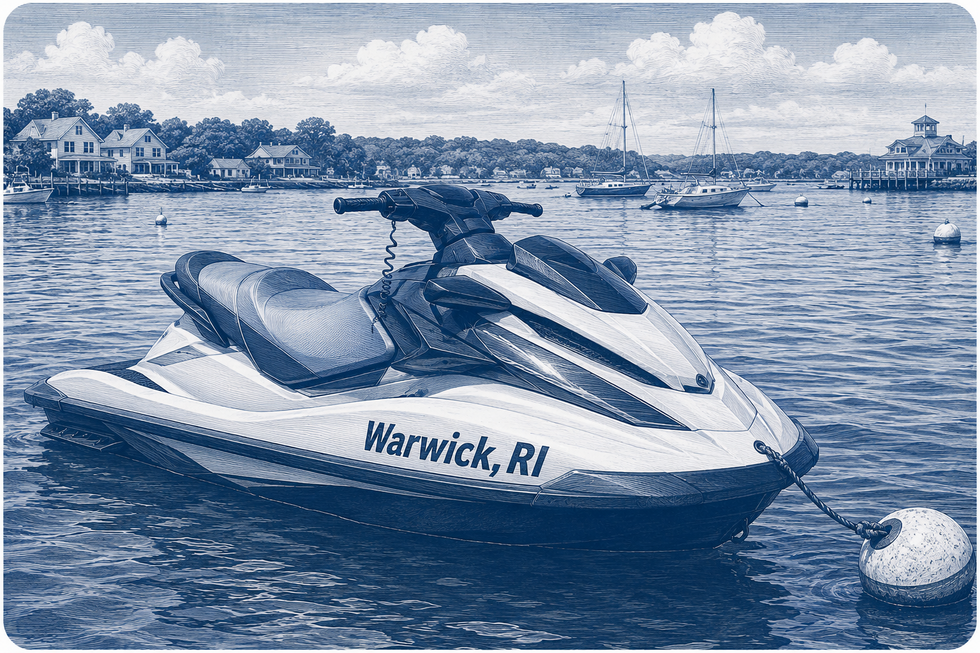
Warwick has more coastline than any other city in Rhode Island — 39 miles of it wrapped around Greenwich Bay, Warwick Neck and the western shore of Narragansett Bay. On a July weekend, Warwick Cove and Apponaug Cove empty their marinas into the bay, families raft up off Oakland Beach and Rocky Point, jet skis buzz the shoreline, quahoggers work the flats, and everyone shares the same narrow dredged channels on the way in and out. Most days on Greenwich Bay end the way they should. Some don't.
Boating accidents in and around Warwick involve all types of vessels, including center consoles, bowriders, pontoon boats, sailboats, jet skis (personal watercraft), rental boats, dinghies, kayaks and paddleboards and the commercial quahog skiffs that work Greenwich Bay year-round.
If you are searching for a boat accident lawyer serving Warwick, Greenwich Bay and Rhode Island waters, it's important to find a boating accident attorney with knowledge of maritime law and boating injury lawsuits — that distinct body of federal law that governs what happens when things go wrong on the water. That's what we do.
Greenwich Bay: Small Water, Big Traffic
Warwick's waters are the opposite of the open Atlantic — and that's exactly what makes them dangerous. The federal government's navigation guide, the U.S. Coast Pilot, describes a bay bordered everywhere by shoal water, where nearly every harbor is reached through a narrow federal channel dredged to just six feet. Warwick's concentration of marinas, yacht clubs, boatyards and rental operations can create liability issues not commonly seen in offshore boating accidents.
Warwick Cove, between Warwick Neck and Horse Neck, is the busiest of them: a 6-foot channel threading past anchorage basins to the head of the cove, a 5-mph speed limit marked off Horse Neck, and what NOAA dryly calls "considerable pleasure boat activity" packed among multiple marinas and boatyards. Apponaug Cove, in the bay's northwest corner, repeats the formula — a marked 6-foot channel, an anchorage basin below a fixed railroad bridge, and a 5-mph zone at the entrance. Oakland Beach, the summer resort on Horse Neck between Warwick Cove and Brush Neck Cove, fronts a flat carrying barely two feet of water — which puts swimmers, waders, jet skis and shallow-draft boats in the same crowded ribbon of water all season long.
The hazards get harder toward Potowomut, where the Coast Pilot warns that rocks with as little as one foot of water over them lurk in the river entrance — its advice is blunt: "strangers should not enter the river" — and Round Rock and a scatter of awash and submerged rocks wait just offshore. Up the eastern side of Warwick Neck, extensive shoals run out toward Ohio Ledge near Rocky Point, and shoal water reaches off Conimicut Point at the mouth of the Providence River, where Warwick's boaters cross the commercial shipping channel serving the Port of Providence.
Shallow water, blind channel bends, packed mooring fields and speed zones that too many operators ignore: when a boating accident happens on waters like these, the question is rarely whether conditions were challenging. It's whether the vessel operator handled them the way a reasonable, careful operator should have.
Common Causes of Warwick Boating Accidents
Most boating accidents on Greenwich Bay and Warwick waters come down to vessel operator negligence. Common causes include:
- Speeding through the 5-mph zones in Warwick Cove and Apponaug Cove
- Dangerous wakes thrown through mooring fields, anchorage basins and raft-ups
- Failing to maintain a proper lookout in violation of the Navigation Rules
- Boating under the influence — a chronic problem in a bay known for its sandbar parties
- Collisions in narrow dredged channels where boats meet head-to-head
- Careless jet ski and rental boat operation near swimmers off Oakland Beach and Conimicut Point
- Groundings and strikes on the rocks and shoals off Potowomut and Warwick Neck
- Inexperienced operators overwhelmed by weekend traffic
Whatever the cause of the Warwick boating accident, a passenger injured on a boat is rarely the one at fault — and Rhode Island law and federal maritime law both give injured boaters the right to pursue compensation from the negligent operator and, in many cases, the boat owner.
Why You Need a Maritime Lawyer, Not Just Any Personal Injury Lawyer
Here's something most people don't learn until after they're hurt: a boat accident is not a car accident that happened to occur on water.
Accidents on navigable waters — and Greenwich Bay, Warwick Cove, Apponaug Cove, the Providence River and Narragansett Bay all qualify — are generally governed by maritime law (also called admiralty law), a body of federal law with its own rules, its own deadlines, and its own defenses. The negligence standards are different. The deadlines can be different. And boat owners can file a federal "limitation of liability" action attempting to cap your recovery at the value of the vessel itself — a tactic that can blindside an injured person whose lawyer has never seen one coming.
Depending on the circumstances, responsible parties may include the vessel operator, boat owner, rental company, marina, boatyard, yacht club or another negligent party.
A personal injury lawyer near you who handles car wrecks and slip-and-falls may be excellent at those cases and still be out of their depth — literally — in a boating accident claim. A boat injury lawyer knows the Navigation Rules, knows how Coast Guard, DEM and harbormaster investigations work, knows how marine insurers operate, and knows how to counter a limitation action. That knowledge is often the difference between a denied claim and full boating injury compensation.
Boat Owner Liability and Vessel Operator Negligence
In many Warwick boating accidents, the person at the helm isn't the only one responsible. The boat owner may be liable for negligently entrusting the vessel to an unfit or intoxicated operator — a recurring fact pattern when family boats and borrowed boats fill a bay like this — or for failing to maintain the vessel or equip it with required safety gear. Rental operations owe their own duties to the customers they send out into crowded water. Marinas and boatyards owe duties to the people on their docks and in their yards. Identifying every liable party — operator, owner, business, or some combination — is part of building a boating accident lawsuit that captures the full value of your claim, and it's work an experienced boat accident attorney should begin before the evidence disappears.
Commercial and Working-Waterfront Accidents
Greenwich Bay isn't just a playground — it's a workplace. Warwick's waters support one of Rhode Island's most storied commercial fisheries: the quahoggers who bullrake the bay's flats in open skiffs, often alone, in all weather. Marina workers, launch operators, mooring crews and boatyard hands earn their living on the same water. If you suffered an offshore injury or were hurt while working on or around the water, an offshore injury lawyer can evaluate your rights under the Jones Act and general maritime law — remedies far more powerful than ordinary workers' compensation, but governed by their own strict requirements. If you're a seaman, commercial shellfisherman, launch operator, boatyard worker or other maritime worker injured on the job, don't assume your only recourse is what the company offers.
Fatal Boating Accidents and Wrongful Death
The worst cases are the ones no settlement can truly fix. When a boating accident on Warwick waters takes a life — a drowning, a swimmer struck by a propeller, a collision in a crowded channel — the family may have a wrongful death claim under maritime law and Rhode Island law. A wrongful death attorney experienced in maritime cases can pursue accountability and compensation while the family focuses on each other. These claims carry firm deadlines. If you've lost a loved one on the water, talk to a lawyer sooner rather than later.
What to Do After a Warwick Boating Accident
Get medical attention immediately, even if you feel okay — serious injuries often surface hours or days later. Report the boat accident; Rhode Island law requires reporting accidents involving injury to the Department of Environmental Management, and Warwick's harbormaster may generate a report as well. Photograph everything, get witness names — on Greenwich Bay in summer, someone almost always saw what happened — and write down what you remember while it's fresh. And be careful with insurance adjusters: don't give a recorded statement or accept a quick offer before speaking with a boating accident lawyer. Early offers almost never reflect what a boating injury claim is actually worth.
Talk to a Warwick Boat Accident Attorney Today
If you were injured on a boat on Greenwich Bay, in Warwick Cove or Apponaug Cove, off Oakland Beach or Conimicut Point or anywhere in Rhode Island waters, get an experienced maritime lawyer in your corner before you make any decisions you can't take back. The consultation is free, it's confidential, and you pay nothing unless we recover for you.
Not every lawyer handles maritime injury claims. If you're dealing with a Warwick boating accident — whether it occurred on Greenwich Bay, on Narragansett Bay, in the Providence River or elsewhere on navigable waters — consider speaking with a lawyer familiar with maritime law and boating accident litigation.
Do I Need a Maritime Lawyer After a Warwick Boating Accident?
Maybe. Many boating accidents occurring on Greenwich Bay and Rhode Island waters are governed by maritime law, which differs significantly from ordinary personal injury law. A boating accident attorney familiar with admiralty and maritime law can help determine what rules apply to your case. An experienced Warwick boat accident lawyer can evaluate the facts of your accident. A maritime lawyer can evaluate the facts of your accident, explain your rights, and help you navigate the unique legal issues that arise when an injury occurs on the water.
How Long Do I Have to File a Warwick, RI Boating Accident Lawsuit?
The deadline depends on the facts of the case and whether maritime law applies. Because important notice requirements and filing deadlines may govern your claim, speak with a boating accident attorney as soon as possible.
Fulweiler llc
East Coast Maritime Injury Lawyers
1-800-383-MAYDAY (6293)