
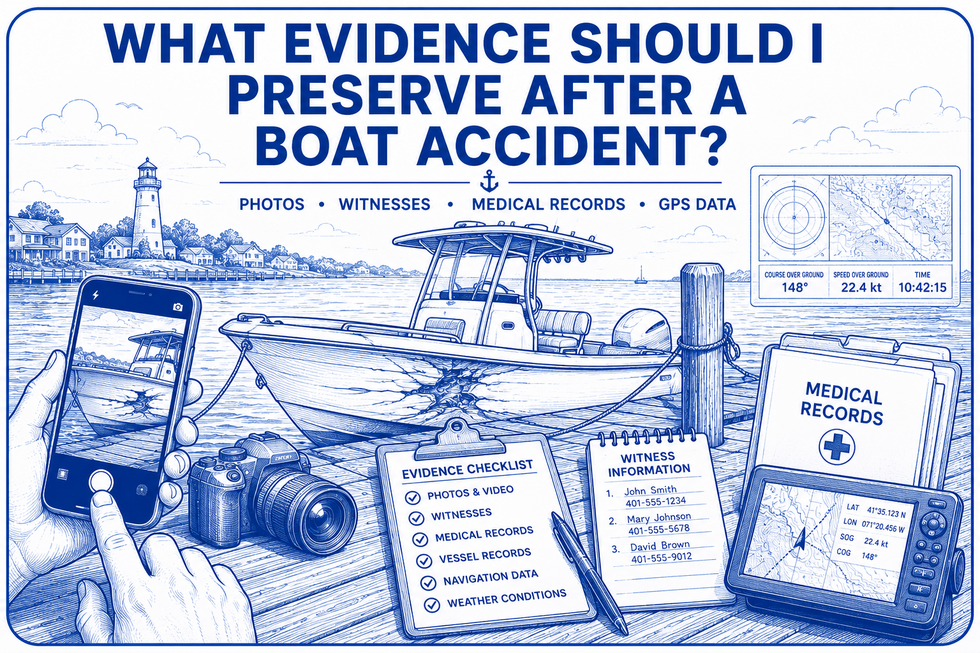
What Evidence Should I Preserve After a Boat Accident?
Evidence is everything in a boat accident claim. Photos of the scene, witness names, medical records, vessel maintenance history — every piece of evidence tells part of the story of what happened. The problem: evidence disappears. Witnesses scatter. Boats get repaired. Marine insurance companies and vessel owners have an incentive to investigate quickly and develop evidence supporting their version of events. Here's what matters, and why.
Photos and Video Are Your Most Powerful Evidence
Photos are the single most important evidence you can preserve. Take pictures of everything: the boat itself (exterior and interior), the scene where the accident occurred, the water conditions, damage to the boat, damage to other vessels involved, your injuries, the weather at the time. Take video if you can — video often captures details photos miss.
For example, if you were thrown from a boat and injured, photos of the railing height, the deck condition, the wave conditions, and your injuries all tell a story. Boat insurance adjusters and juries can see what happened. For example, if you suffered a propeller strike, photos of the vessel, the propeller condition, the location where you were struck, and your injuries are powerful evidence of liability.
Get these photos immediately if you can. If you're hospitalized or too injured to do it yourself, ask a family member or friend to document everything. The sooner the better — as time passes, boats get repaired, weather changes, and the scene is cleaned up.
And, remember, an experienced maritime lawyer will have the resources to gather this information if you don't. A boat injury lawyer will know how to quickly access and preserve this evidence.
Witness Information Is Critical
Get the names, phone numbers, and email addresses of every person who witnessed the accident or saw your injuries immediately afterward. For example, if you were injured on a charter boat, get the names of other passengers. If you were injured on a ferry, get names of other passengers and crew members who saw the accident. If you were injured while working on a commercial vessel, get names of crew members who were present.
Witnesses have short memories. People move. Phone numbers change. If you wait weeks to get witness information, witnesses may no longer be reachable. Insurance companies know this — they often interview witnesses quickly, and those witness statements may contradict your account later.
Write down what each witness saw while it's fresh. A simple note: "John Smith, (401) 555-1234, was standing near me when the boat hit the wake. He saw me get thrown across the cabin." That simple note is gold later.
Medical Records and Documentation
Seek medical attention immediately — not just for your health, but for the record. A medical record dated the day of the accident proves when your injury occurred and establishes that you took the injury seriously. For example, if you suffered a back injury in a boat collision and didn't see a doctor for three weeks, the insurance company will argue the injury wasn't caused by the accident. An emergency room visit on the day of the accident makes that argument much harder.
Keep all medical records, bills, test results, imaging (X-rays, MRI, CT scans), and notes from providers. If your injury requires ongoing treatment, keep records of all that treatment. These documents prove the extent of your injury and the cost of medical care.
Boat Maintenance Records
If the accident involved equipment failure — a defective winch, a failed engine, a malfunctioning hydraulic system — maintenance records matter. For example, if a commercial fishing vessel's winch failed and a crewmember was injured, records showing the winch hadn't been inspected or maintained in years support an unseaworthiness claim.
These records are usually in the boat owner's or ferry company's possession, not yours. But an experienced maritime lawyer knows how to make a demand for these records through the legal process. And an experienced boating accident lawyer will know how to demand preservation of these records even if no legal process has been commenced.
Weather and Water Conditions
Document the weather and water conditions at the time of the accident. Was it foggy? Were there large waves? Was the wind strong? What was the visibility? For example, if you were injured when a boat hit a large wake in rough water, notes about the wave conditions and visibility support a claim that the operator wasn't maintaining a proper lookout or was operating recklessly.
You can get this information from multiple sources: your own memory and notes, weather services (NOAA, National Weather Service), Coast Guard records, and testimony from other people present.
Navigation and Radar Data
Commercial vessels — ferries, tugs, fishing boats — maintain navigation logs, radar recordings, and GPS data. This data shows where the vessel was, how fast it was traveling, what the operator could see on radar, and what route was taken. For example, if a ferry was traveling at excessive speed in fog and struck another vessel, radar data can prove the operator was operating recklessly.
Your boating injury lawyer can subpoena this data from the boat owner or ferry company and/or request the potential defendant preserve these materials.
Crew Logs and Incident Reports
Commercial vessels maintain crew logs and incident reports. These documents show what happened, who was involved, what injuries occurred, and what the crew observed. They're often the first official account of the accident and can be powerful evidence.
Your maritime lawyer can obtain these documents.
Why Evidence Disappears
Time is the enemy. Witnesses move away or forget details. Boats get repaired, erasing evidence of damage. Boat owners and insurance companies have incentives to make inconvenient evidence disappear. For example, if a vessel had a known equipment defect, the owner might repair it quickly and discard records of the defect.
Insurance companies know that memory fades and evidence degrades. The longer you wait to preserve evidence, the weaker your claim becomes.
Common Mistakes to Avoid
Don't assume you'll remember details later. Write things down now. Don't assume witnesses will stay in touch. Get their information immediately. Don't delay seeking medical attention — a day or two can hurt your credibility. Don't touch or board the vessel after the accident without a lawyer's guidance — you might be accused of altering evidence. Don't give a recorded statement to the boat owner's insurance adjuster without talking to a maritime lawyer first — you might say something that hurts your claim.
Preservation Letters
If the evidence you need is in someone else's possession — the boat owner, the ferry company, the charter boat operator — a maritime lawyer can send a formal preservation letter demanding that the evidence be preserved and not destroyed or altered. This letter creates a legal obligation, and failure to preserve evidence can result in sanctions against the defendant.
A preservation letter is your insurance against evidence being destroyed.
What You Should Do Now
If you were injured in a boat accident, start preserving evidence immediately. Take photos. Get witness names. Seek medical attention. Write down what you remember. Then call a maritime lawyer. Don't wait weeks or months — the sooner a lawyer gets involved, the sooner evidence can be formally preserved and protected.
You don't have to hire a lawyer immediately. But you need to talk to an experienced maritime injury lawyer soon enough that evidence preservation isn't an afterthought.
Fulweiler llc
East Coast Maritime Injury Lawyers
1-800-383-MAYDAY (6293)

Comments
There are no comments for this post. Be the first and Add your Comment below.
Leave a Comment