
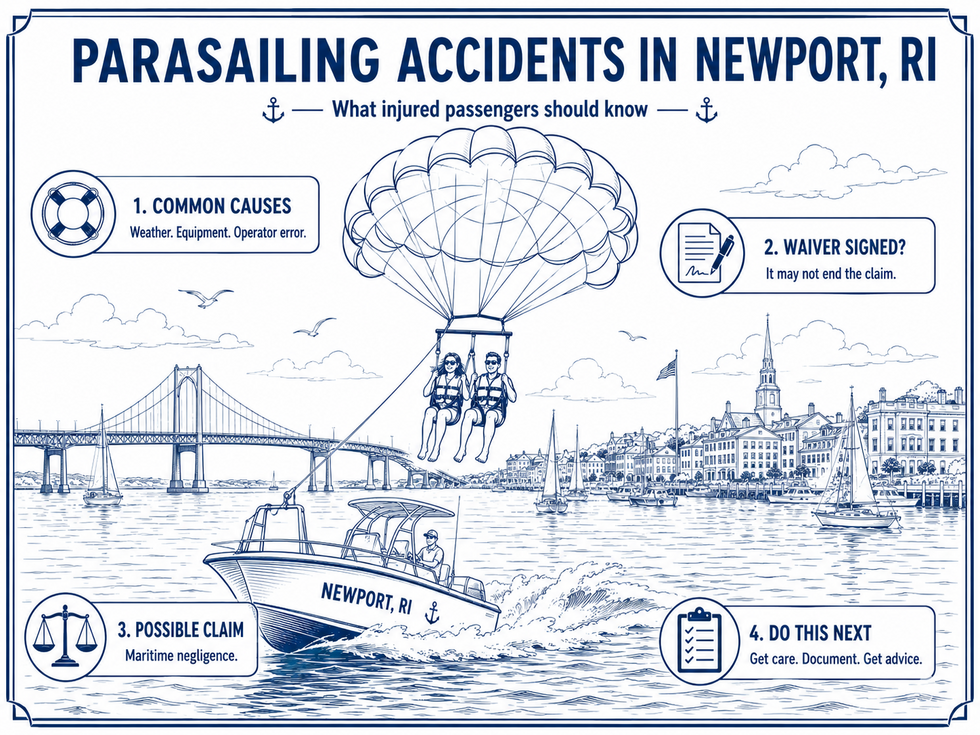
Parasailing Accidents in Newport, RI: What Injured Passengers Need to Know
Newport's harbor and Narragansett Bay draw thousands of visitors every summer looking for a good view of the coastline from a few hundred feet in the air. Parasailing is marketed as a safe, controlled recreational activity. Most trips end exactly that way: a short flight, a view of the bay, and a safe return to the boat.
But when something goes wrong, it can go wrong fast. A parasailing accident can involve a hard water impact, a collision with a dock or vessel, a towline failure, a fall from height, or a passenger being dragged through the water. The injuries can be serious.
If you or someone you love was hurt while parasailing in Newport, here is what you need to know about how these cases work and what claims may be available.
Why Parasailing Accidents Happen
Parasailing may look simple from shore: a boat, a winch, a harness, a towline and a parachute. In practice, it depends on several things going right at the same time. The equipment must be maintained. The operator must be trained and attentive. The weather must be monitored. Passenger weight, wind, sea state and vessel traffic all matter.
Common causes of parasailing injuries include:
• Equipment failure, including worn towlines, harness problems, winch issues or parasail defects
• Operator error, including poor launch or retrieval decisions
• Misjudging wind, weather, sea state or passenger weight
• Towing too close to shore, docks, piers, structures, rocks or other vessels
• Failing to properly instruct or supervise passengers before launch
• Overloading or improper weight distribution
• Failing to maintain the vessel, towline, harness, winch, parasail and related equipment according to applicable regulations, manufacturer instructions and accepted industry practices
• Continuing a trip when changing conditions should have caused the operator to stop
When one of these failures occurs, a passenger may be dropped, dragged, slammed into the water, or carried into a structure or another vessel. Injuries can include broken bones, dislocated joints, spinal injuries, head trauma, near-drowning injuries and, in the worst cases, death.
Does a Waiver Mean I Cannot Sue?
“The parasailing company made me sign a waiver before we went out. Doesn't that mean I have no claim?”
Not necessarily.
A dockside waiver does not automatically end a parasailing injury claim. Waivers need to be reviewed under the facts of the incident, the wording of the document and the law that applies. In maritime passenger cases, federal law may limit the ability of a vessel owner or operator to contract away responsibility for personal injury or death caused by negligence.
A waiver also may not protect an operator from gross negligence, reckless conduct, regulatory violations or conduct outside the scope of what the passenger actually agreed to.
The practical point is simple: do not assume the waiver decides the case. Have it reviewed before you conclude you have no claim.
Who Can Be Held Responsible?
Responsibility for a parasailing accident depends on what happened and why it happened.
Potentially responsible parties may include:
• The parasailing operator
• The boat captain or crew
• The company that owns or operates the vessel
• The company that owns or maintains the parasailing equipment
• A manufacturer, if defective equipment contributed to the accident
• A dock, marina or property owner, if an unsafe structure/condition played a role
These cases often turn on documents and evidence that passengers do not have access to right away, including maintenance records, weather information, incident reports, inspection records, photographs, videos, crew statements and insurance communications.
That is why early investigation matters.
What Kind of Claim Applies?
Parasailing accidents in Newport waters usually involve passenger claims under general maritime law, not the Jones Act.
The Jones Act protects seamen employed aboard vessels. It generally does not apply to paying passengers on a recreational parasailing trip.
That distinction matters. A parasailing injury case may involve general maritime negligence law, Rhode Island law, or both, depending on where the accident occurred and what happened. Those questions can affect the available claims, defenses, deadlines and damages.
This is exactly the kind of issue that can trip up a general personal injury lawyer who does not regularly handle water-based injury claims. A maritime injury lawyer or boating accident attorney familiar with Newport Harbor and Narragansett Bay can evaluate which law applies and how the claim should be built.
What Damages May Be Available?
An injured parasailing passenger may be able to recover damages for:
• Past and future medical expenses
• Surgery, rehabilitation, therapy and follow-up care
• Lost wages
• Loss of future earning capacity
• Pain and suffering
• Permanent injury or disability
• Scarring or disfigurement
• Loss of enjoyment of life
• Wrongful death damages, where the accident is fatal
The value of the claim depends on the facts, the injuries, the available insurance, the applicable law and the strength of the evidence showing what the operator did wrong.
Because parasailing companies usually have business liability insurance, the insurer may become involved quickly after an accident. That can include requests for recorded statements, forms, authorizations or early settlement discussions. An injured passenger should be careful before giving statements or signing anything without first understanding their rights.
Newport-Specific Considerations
Newport Harbor and Narragansett Bay are busy in the summer. Parasailing boats may be operating near sailboats, powerboats, ferries, fishing vessels, tour boats, docks, mooring fields and heavy recreational traffic.
That local setting matters.
A parasailing operator must account for more than just the passenger in the harness. The operator must consider wind, visibility, vessel traffic, current, launch area, retrieval area, nearby structures and changing conditions on the bay.
A Newport boating accident lawyer familiar with local waters may be better positioned to identify where the operator's decisions fell short and what evidence should be preserved.
What Should I Do After a Parasailing Accident?
If you were hurt parasailing, take these steps as soon as possible:
• Get medical attention immediately, even if the injury seems minor at first. Head, spine and internal injuries are not always obvious right away.
• Report the incident and make sure it is documented in writing.
• Take photographs of the boat, equipment, harness, towline, parasail, weather conditions and visible injuries if you can.
• Get the names and contact information of witnesses, including other passengers.
• Avoid giving a recorded statement to the company's insurance representative before speaking with a maritime attorney.
• Do not sign a release, settlement agreement or broad medical authorization without independent legal advice.
• Contact a maritime injury attorney promptly so evidence such as maintenance logs, weather data, video footage and crew statements can be preserved.
Evidence in boating and parasailing accident cases can disappear quickly. Equipment may be repaired or replaced. Crew members may move on. Weather and vessel-location data may not be saved indefinitely. The sooner the investigation begins, the better.
The Bottom Line
Parasailing is supposed to be a safe, enjoyable way to see Newport and Narragansett Bay. Most trips are exactly that.
But when an operator cuts corners on equipment, training, passenger safety or weather judgment, the consequences can be life-changing.
If you were injured in a parasailing accident in Newport, do not assume a waiver ends your claim. Do not assume ordinary personal injury rules apply. And do not let the company or its insurer control the story before you understand your rights.
A maritime injury attorney who understands admiralty law, boating accidents and the local waters can help determine what happened, who may be responsible and what compensation may be available.
Fulweiler llc
East Coast Maritime Injury Lawyers
1-800-383-MAYDAY (6293)

Comments
There are no comments for this post. Be the first and Add your Comment below.
Leave a Comment