
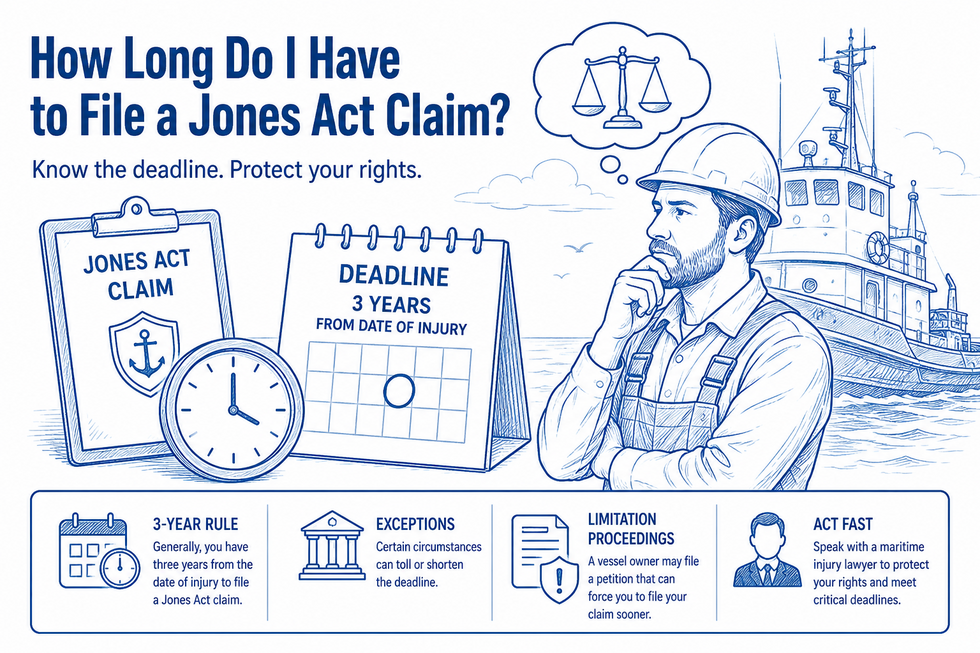
Generally, you have three years from the date of injury to file a Jones Act claim. But "generally" is doing a lot of work in that sentence. The Jones Act — federal maritime law that protects seamen and maritime workers — has its own timeline rules, and missing the deadline means your claim is gone. Forever. Not delayed. Gone.
Plus, a boat owner might file a Limitation of Liability Petition which can force a Jones Act crewmember to file a claim long before the three year period. You read that right – a vessel owner can force you to file a claim and missing that filing deadline and, again, your claim is likely gone.
Who Has a Jones Act Claim?
The Jones Act generally applies to seamen — typically these are workers who spend a substantial portion of their employment serving a vessel or fleet of vessels in navigation – but there can be exceptions. The Jones Act applies to seamen and maritime workers — commercial fishermen, ferry crews, tug operators, charter captains and crew, offshore wind farm workers, marine construction crews, yacht crew, charter boat crew and anyone else who works on a vessel. It does NOT typically apply to recreational passengers on a friend's boat or a pleasure cruise. (A good maritime lawyer should be consulted because sometimes you may have Jones Act rights even though you thought you were aboard for ‘fun'.)
If you were injured while working on the water in Rhode Island or anywhere else, the Jones Act may give you rights that are stronger than ordinary workers' compensation. But those rights come with strict timelines.
The Three-Year Rule — But It's More Complicated Than It Sounds
The basic deadline is three years from the date you were injured. If you were hurt on January 15, 2023, you have until January 15, 2026 to file your claim. After that, your claim is barred. A court won't hear it. Your employer's boat owner's insurance won't pay it. You're done.
But here's where it gets tricky. That three-year clock doesn't account for tolling, discovery rules, federal maritime procedure or the fact that your employer or the vessel owner might file their own federal maritime action (a Petition to Limit Liability) that changes your deadline. Some courts have found that certain circumstances can toll (pause) the statute of limitations. Others haven't. The law varies by jurisdiction and by the specific facts of your injury.
The point: you can't rely on "three years" without understanding your particular situation making it very important to speak with a boat injury lawyer to understand your unique maritime rights and the time in which you have to pursue them.
How a Jones Act Claim Is Different From a Recreational Boat Accident Claim
If you were an injured passenger on a recreational boat — a friend's sailboat, a charter fishing trip, a sightseeing cruise — your claim typically falls under general maritime law, not the Jones Act. The deadlines are similar (three years in many cases), but the remedies are different. As a recreational injured passenger, you'd make a boat accident claim against the boat owner's insurance or the charter company's insurance. You'd rely on negligence law.
As a seaman under the Jones Act, you don't have to prove the employer was the primary cause of your injury. You just have to prove the employer failed in their duty to provide a safe workplace or safe equipment, and that failure played any role — even a minor one — in causing your injury. Courts call this "featherweight causation." The employer's breach doesn't have to be the main reason you got hurt. It just has to be a reason. That's enormously powerful compared to regular injury law, where you'd have to prove negligence and causation.
Boat Insurance Claims and Maritime Workers
A Rhode Island boat accident involving a recreational injured passenger typically goes through boat insurance claims — the boat owner's insurance investigates, adjusts, and pays. A Jones Act claim involving a maritime worker goes directly to the employer and their insurance, but it operates under federal maritime law, not state boat accident law.
The procedures are different. The deadlines are different. The defenses available to the employer are different. And the insurance coverage might be different too.
Why the Deadline Matters So Much
Maritime workers often don't realize they've been injured seriously until weeks or months after the accident. A back injury like a herniated disk from lifting heavy gear might not become apparent for months. A respiratory issue from exposure might develop slowly. But the three-year clock starts running the day you were injured — not the day you realized you were hurt, and not the day you hired a boat lawyer.
If you wait too long thinking "it's fine" or "I'll deal with it later," you'll miss the deadline. And once it's gone, there's no recovery. No boat insurance claims. No compensation. Nothing.
What You Should Do Right Now
If you were injured while working on a vessel — a fishing boat, a ferry, a tug, a barge, an offshore rig, a charter boat, a yacht, a launch, a tow boat, a fast ferry, a sailboat, a powerboat or any other maritime workplace — don't wait. Call a maritime lawyer immediately. Not in a few months. Not after you've "seen how it goes." Now – you don't have to hire them, but you need to understand your maritime legal rights and the time by which you have to make a claim.
A maritime lawyer can determine whether you have a Jones Act claim, understand the specific deadlines that apply to your situation, and make sure you don't miss critical deadlines. They can also preserve evidence and investigate your claim before memories fade and records disappear.
The three-year rule sounds simple until you're six weeks away from it and just realized you should have called a lawyer.
Fulweiler llc
East Coast Maritime Injury Lawyers
1-800-383-MAYDAY (6293)

Comments
There are no comments for this post. Be the first and Add your Comment below.
Leave a Comment