
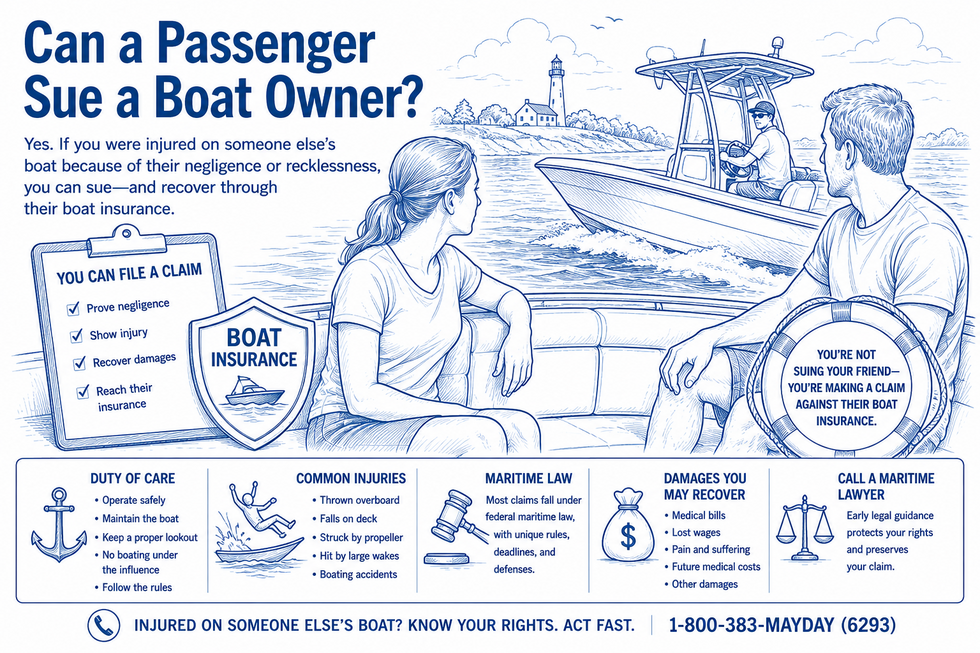
Can a Passenger Sue a Boat Owner?
Yes. If you were injured on someone else's boat because of the boat owner's negligence or recklessness, you can sue the boat owner. And more importantly, you can sue to reach their boat insurance. That's the point of marine insurance — it exists to cover exactly these situations.
But not every passenger injury is actionable. You have to prove the boat owner breached a legal duty and that breach caused your injury. A boat accident lawyer can you help you understand your maritime legal rights. Here's some general information you need to know.
What Legal Duty Does a Boat Owner Owe to Passengers?
A boat owner owes a passenger a duty to operate the vessel safely under the circumstances. That means: Maintaining the boat in reasonably safe condition. Operating at a reasonable speed. Keeping a proper lookout for other vessels, obstacles, and swimmers. Warning passengers before hitting rough water or large wakes. Not boating under the influence. Following the Navigation Rules. Ensuring passengers wear life jackets (especially children — Rhode Island law requires life jackets for all children 12 and under). Having proper safety equipment aboard.
If a boat owner breaches any of these duties and you get hurt as a result, you have a claim. It doesn't matter whether the boat owner is a friend, family member, coworker, or stranger. It doesn't matter that they didn't mean to hurt you.
What Kinds of Passenger Injuries Lead to Claims?
Passengers get injured when boat owners hit large wakes without warning. Passengers get thrown overboard. Passengers fall on deck from sudden maneuvers. Passengers are struck by booms on sailboats. Passengers are struck by propellers. Passengers trip and fall. Passengers suffer traumatic brain injuries (TBI). Passengers are injured in groundings. Passengers are injured when boats capsize because of excessive speed or overloading.
The common thread: the boat owner either did something or failed to do something required by law.
You're Not Suing Your Friend — You're Suing Their Boat Insurance
This is the part that stops people. They think: "I can't sue my friend."
But you're not. You're making a claim against their boat owner's insurance — the liability coverage that sits on their policy. Your friend paid for that vessel insurance specifically so that if someone gets hurt on the boat, the marine insurance handles it. The insurance company investigates, adjusts the claim, and pays it (assuming liability is clear). Your friend doesn't write you a check. The insurance company does.
That's how it works. And that's why boat insurance exists.
Maritime Law vs. State Negligence Law
Here's where it gets important: many passenger injury claims occurring on navigable waters fall under maritime law — federal law with its own rules, deadlines, procedures and defenses. It's typically not state negligence law. That distinction matters.
Under maritime law, you have typically have three years to file a claim from the date of injury. After that, your claim is barred. You also need to understand that certain defenses are available to boat owners under maritime law that wouldn't be available in a car accident. And if the boat owner files a federal Limitation of Liability Petition, your claim might be forced into a specific proceeding with specific deadlines that you need to know about – meaning you might have to file a claim a lot quicker than the three year timeline.
This is why you need a maritime lawyer, not a general personal injury attorney who handles car wrecks. You need a skilled boat accident lawyer who knows and understands this law and can help you preserve your boat injury claim.
What Makes a Strong Passenger Injury Claim?
A strong claim has clear causation. You were on the boat. The owner did something negligent or reckless. You got hurt as a result. The injury is real — medical records, bills, lost wages, ongoing pain. The boat owner had boat insurance at the time of injury.
Weaker claims are harder to prove: you were injured but can't connect it to anything the owner did, or the owner's conduct was careless but not negligent, or the injury is minor.
But here's the thing: even weak claims sometimes be resolved. Insurance companies know that litigation is expensive. They know juries can be unpredictable. So even if your claim seems marginal, it's worth talking to a maritime lawyer. The settlement value might surprise you.
Alcohol and Recklessness Make Claims Stronger
If the boat owner was boating under the influence (BUI), your claim gets stronger. If they were operating recklessly — excessive speed, no lookout, ignoring Navigation Rules — your claim gets stronger. If they were on their phone or distracted, your claim gets stronger. These facts don't just prove negligence. They suggest willfulness or gross negligence, which can open the door to higher damages and, in some cases, punitive damages.
Do You Need Proof of Negligence Before You Call a Lawyer?
No. You need to be injured and believe the boat owner caused it. A maritime lawyer can investigate, reconstruct the accident, interview witnesses, review the boat owner's maintenance records and determine whether you have a viable claim. You don't need to prove your case before you talk to someone who knows maritime law.
Can an Injured Passenger Recover Medical Bills and Lost Wages?
Yes. An injured passenger may be entitled to recover medical expenses, lost income, pain and suffering, future medical costs, and other damages depending on the nature of the boating accident and resulting injuries.
What You Should Do Now
If you were injured on someone else's boat in Rhode Island waters or anywhere else, call a maritime lawyer. Not in a few weeks. Not after you've tried to handle it yourself. Now. Early investigation preserves evidence, locks in witness memory and gives you time to understand your rights before the statute of limitations clock runs down.
You don't have to hire them. If you were injured as a passenger in a Rhode Island boat accident, it is important to understand your rights before speaking with the insurance company. But you need to understand whether you have a claim, what it might be worth, and how much time you have to pursue it. A free consultation gives you that clarity.
Fulweiler llc
East Coast Maritime Injury Lawyers
1-800-383-MAYDAY (6293)

Comments
There are no comments for this post. Be the first and Add your Comment below.
Leave a Comment